
Introduction
Sikhism is one of the world's youngest major religions, founded in the Punjab region of South Asia just over five centuries ago. Today it is practiced by more than 25 million people around the world, making it the fifth-largest organized religion globally. Sikhism has developed a rich tradition of scripture, worship, history, and community life that continues to shape the identity of millions of Sikhs across Punjab and the global diaspora
Origins and the Founder
Sikhism originated with Guru Nanak Dev Ji, who was born in 1469 in Rai Bhoi Ki Talwandi, a town now known as Nankana Sahib. Situated in the Punjab region of present-day Pakistan, Guru Nanak was raised during a time of considerable religious and social unrest across the Indian subcontinent. Society was deeply influenced by rigid caste divisions, ritualistic practices, and growing separations between different religious communities, all of which shaped everyday life.
From a young age, Guru Nanak showed an unusual spiritual disposition, often questioning the religious customs of his time. According to Sikh tradition, a transformative spiritual experience led him to begin a new path of teaching, one centered on a direct, personal connection with the divine rather than ritual observance or social hierarchy. He spent much of his life undertaking extensive missionary journeys, known as the *Udasis*, which took him across the Indian subcontinent and to regions beyond. During these travels, he engaged with religious leaders, scholars, and ordinary people from diverse backgrounds, sharing his teachings through hymns, dialogue, and discourse.
Guru Nanak eventually settled in Kartarpur, where he established a community that lived according to the principles he taught. This community became the foundation of what would grow into the Sikh faith.
The Ten Gurus
Before his passing, Guru Nanak appointed a successor to continue his mission, beginning a line of spiritual leadership that would span ten Gurus over roughly two and a half centuries. Each Guru built upon the foundation laid by his predecessors while responding to the needs and challenges of his own time.
The succession continued with Guru Angad Dev Ji (1504–1552), the second Guru, who standardized and promoted the Gurmukhi script, which later became the primary script for recording Sikh scripture and teachings; Guru Amar Das Ji (1479–1574), the third Guru, who expanded the Sikh community's institutions and emphasized social equality; Guru Ram Das Ji (1534–1581), the fourth Guru, who laid the foundation of the city of Amritsar; and Guru Arjan Dev Ji (1563–1606), the fifth Guru, who compiled the *Adi Granth*, the first authorized compilation of Sikh scripture, and oversaw the construction of the Harmandir Sahib, widely known as the Golden Temple.
The later Sikh Gurus guided the community through a period of growing political challenges and persecution. Guru Hargobind Sahib Ji (1595–1644), the sixth Guru, introduced the concept of *Miri-Piri*, emphasizing the integration of spiritual and temporal authority. Guru Har Rai Ji (1630–1661), the seventh Guru, continued to strengthen the Sikh community while promoting compassion and service. Guru Har Krishan Sahib Ji (1656–1664), the eighth Guru and affectionately remembered as *Bala Pritam*, is revered for his humility and selfless service to those suffering during an epidemic in Delhi. Guru Tegh Bahadur Ji (1621–1675), the ninth Guru, is revered for sacrificing his life to uphold religious freedom and defend the right of all people to practice their faith without coercion. The line of human Gurus concluded with Guru Gobind Singh Ji (1666–1708), the tenth Guru, who founded the Khalsa in 1699, formalized the distinct Sikh identity, and bestowed eternal Guruship upon Guru Granth Sahib Ji, bringing the succession of human Gurus to an end.
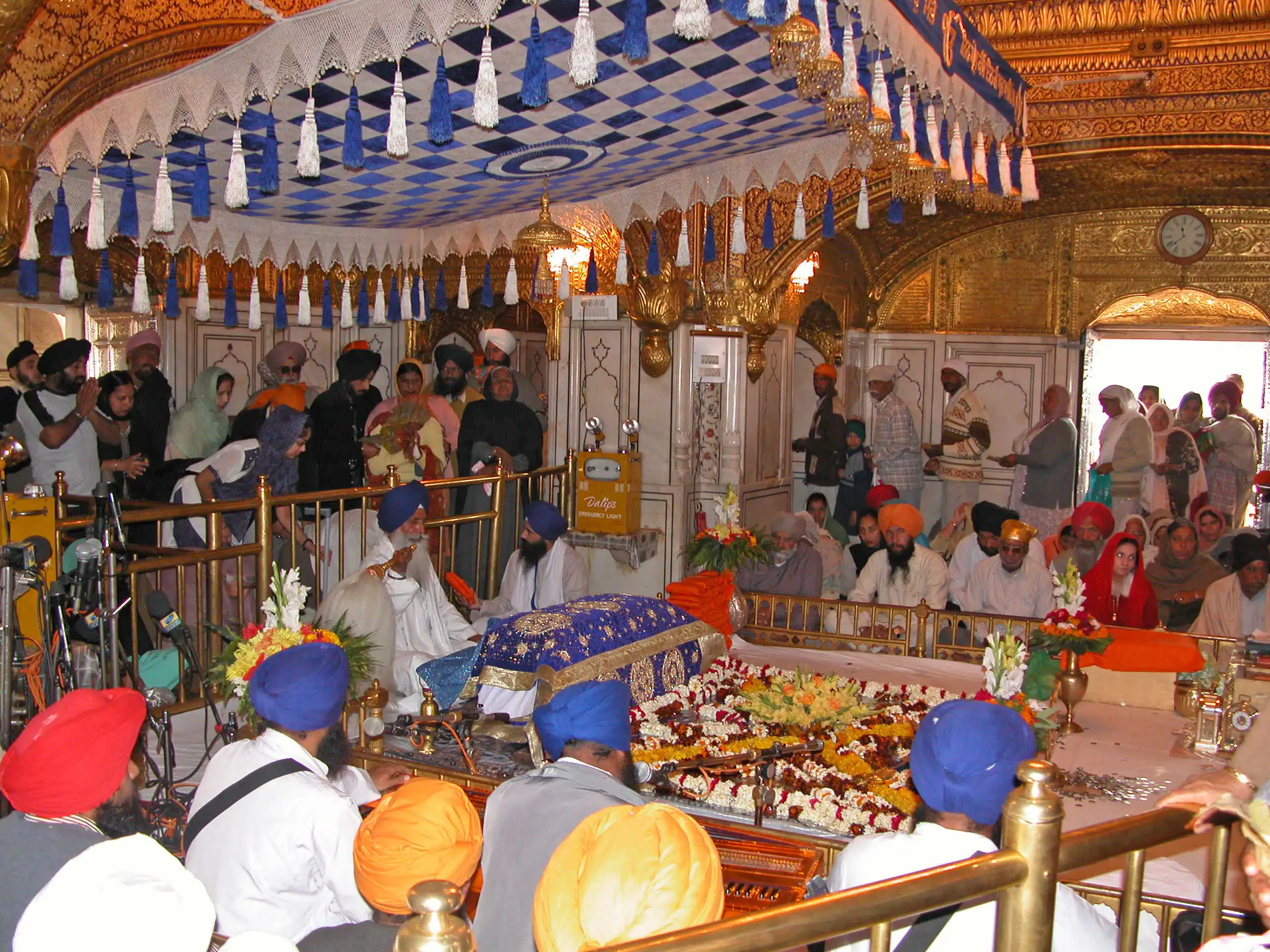
Guru Granth Sahib: The Eternal Guru
The Guru Granth Sahib occupies a unique place in Sikhism as both its sacred scripture and its eternal Guru.
A defining feature of Sikhism is its scripture, the Guru Granth Sahib. Compiled over generations and given its final form by Guru Gobind Singh Ji in 1708, it contains the divine hymns of the Sikh Gurus as well as selected writings of revered saints and devotees from diverse spiritual traditions and social backgrounds, including Bhagat Kabir Ji, Sheikh Farid Ji, Bhagat Ravidas Ji, Bhagat Namdev Ji, Bhagat Sain Ji, Bhagat Dhanna Ji, Bhagat Pipa Ji, and others, whose compositions were incorporated into the scripture because of their universal spiritual wisdom and harmony with the message of Gurbani.
Before his passing, Guru Gobind Singh Ji declared that there would be no further human Gurus and bestowed eternal Guruship upon Guru Granth Sahib Ji. Since then, Guru Granth Sahib Ji has served as the eternal Guru of the Sikh community. This is why the scripture is treated with the same reverence as a living spiritual teacher
Guru Granth Sahib Ji is ceremonially and reverentially seated upon the throne (Takht) in every Gurdwara. The recognition of scripture itself as the eternal Guru of the faith is regarded as a distinctive feature of Sikhism among the world's major religions.
The Khalsa
In 1699, Guru Gobind Singh Ji established the Khalsa, the collective body of initiated Sikhs committed to living according to the Guru's teachings, upholding righteousness, defending justice, and maintaining a distinct Sikh identity guided by the Sikh code of conduct. This was a pivotal moment in Sikh history, occurring during a time of severe persecution of religious minorities in the region.
Members of the Khalsa adopted five articles of faith, often referred to as the Five Ks, which remain visible markers of Sikh identity today. The formation of the Khalsa also established a framework of discipline, equality, and collective responsibility that continues to influence Sikh institutions and community organization.
Worship and Community Life
Sikh communal life centers on the Gurdwara, literally meaning "doorway to the Guru." A Gurdwara is far more than a place of worship; it functions as a community hub where people gather for prayer, learning, and service. Central to Gurdwara life is Kirtan, the singing of hymns from the Guru Granth Sahib, which forms a core part of Sikh worship.
Perhaps the most widely recognized institution associated with Sikhism is the Langar, a free community kitchen found in every Gurdwara. Originating with Guru Nanak and formalized by later Gurus, the Langar serves meals to anyone who visits, regardless of religion, caste, gender, or social status. Volunteers prepare and serve the food, and everyone sits together on the floor to eat as equals. The Langar remains one of the most visible expressions of Sikh community values in practice, feeding millions of people daily at Gurdwaras around the world.
The Sangat, or congregation, is another central concept, referring to the community of people who gather together for worship, service, and mutual support.
Sikhism in the World Today
From its origins in Punjab, Sikhism has grown into a global faith. While Punjab remains the spiritual and historical heartland of the Sikh community, and home to important historical Gurdwaras, significant Sikh populations now live across North America, the United Kingdom, Australia, and many other countries, forming vibrant diaspora communities that maintain strong ties to their heritage.
Sikh history is also closely tied to the rise of the Sikh Empire in the early 19th century under Maharaja Ranjit Singh, as well as the broader history of Sikh military traditions, which grew out of the events surrounding the formation of the Khalsa.
Sikhism stands today as a distinct tradition with its own scripture, history, institutions, and global community, shaped by the lives and teachings of its ten Gurus and the events that followed in the centuries since.