
Introduction — Sikh Warriors & Generals
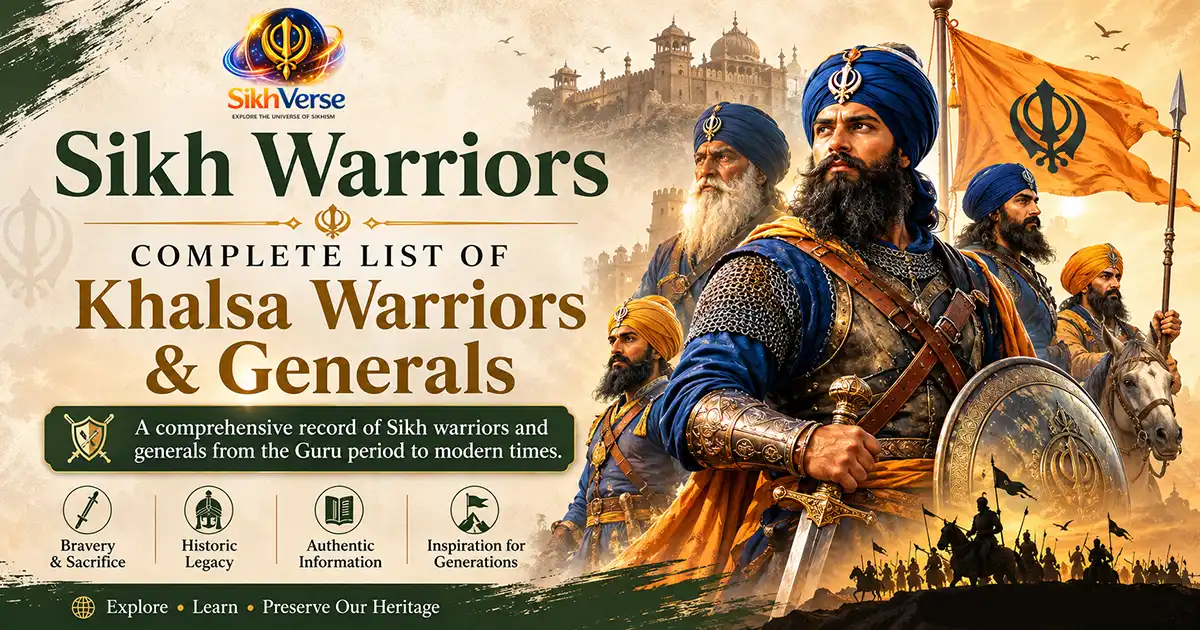
Throughout history, Sikh warriors and generals (ਸਿੱਖ ਯੋਧੇ) have been known for their unmatched bravery, strategic brilliance, and unwavering commitment to the principles of the Khalsa. From the early martyrs who defended their faith to the legendary generals who expanded the Sikh Empire, these warriors embodied the Sant-Sipahi (Saint-Soldier) ideal.
The Sikh martial tradition began with Guru Hargobind Ji, who introduced militarization to Sikhi and established the Akal Sena (Army of the Immortal). The tradition was formalized by Guru Gobind Singh Ji, who created the Khalsa in 1699 and taught the concept of Dharma Yudh — war fought as a last resort to defend righteousness.
This page documents every major Sikh warrior — from the Guru period to modern times.
- First Sikh Warrior: Guru Hargobind Ji
- Greatest Sikh Warrior: Hari Singh Nalwa
- Legendary Martyr: Baba Deep Singh
- First Female Warrior: Mai Bhago
- Most Famous Last Stand: Saragarhi (1897)
- Total Warriors: 30+ documented
- Key Opponents: Mughals, Afghans, British
Guru Period Warriors
This section covers warriors who fought under the Sikh Gurus, beginning with Guru Hargobind and continuing through Guru Gobind Singh.
Bhai Bhai Bachittar Singh (1664–1705)
Bhai Bachittar Singh
1664–1705
A legendary Sikh warrior who fought in the Battle of Chamkaur (1704) alongside Guru Gobind Singh. He is known for single-handedly breaking through Mughal lines and carrying a massive spear into battle. He was martyred at the Battle of Chamkaur.
Key Battles: Battle of Chamkaur (1704)
See more →Bhai Bhai Daya Singh (1661–1708)
Bhai Daya Singh
1661–1708
One of the original Panj Pyare (Five Beloved Ones) who answered Guru Gobind Singh's call at the creation of the Khalsa in 1699. He was the first to offer his head to the Guru and was baptized into the Khalsa. He fought alongside Guru Gobind Singh in multiple battles.
Key Battles: Battle of Chamkaur, Battle of Muktsar
See more →Bhai Bhai Dharam Singh (1666–1708)
Bhai Dharam Singh
1666–1708
One of the original Panj Pyare (Five Beloved Ones) who offered his head to Guru Gobind Singh at the creation of the Khalsa in 1699. He fought alongside the Guru in several battles and was martyred defending the Khalsa.
Key Battles: Battle of Chamkaur, Battle of Muktsar
See more →Bhai Bhai Mani Singh (1644–1734)
Bhai Mani Singh
1644–1734
A renowned Sikh scholar, warrior, and compiler of the Dasam Granth. He served as the Granthi (head priest) of the Golden Temple and fought in several battles. He was martyred in 1734 for refusing to convert to Islam.
Key Battles: Various Mughal-Sikh engagements
See more →Bhai Bhai Taru Singh (c. 1720–1745)
Bhai Taru Singh
c. 1720–1745
A Sikh martyr and warrior who refused to convert to Islam. He was tortured and executed by the Mughals. His scalp was removed while he was alive because he refused to cut his hair.
Key Battles: Mughal persecution
See more →Banda Singh Bahadur & His Generals (1708–1716)
After Guru Gobind Singh's death, his disciple Banda Singh Bahadur led the Sikhs in a series of successful campaigns against the Mughals.
Banda Singh Bahadur (1670–1716)
Banda Singh Bahadur
1670–1716
Born Lachhman Dev, he was a Hindu ascetic named Madho Das before meeting Guru Gobind Singh in 1708. He was baptized into the Khalsa and given the name Banda Singh Bahadur. He established the first Sikh state in Punjab, abolished the zamindari system, and granted land to farmers. He was captured at Gurdas Nangal and martyred in Delhi in 1716.
Key Battles: Battle of Samana (1709), Battle of Sirhind (1710), Siege of Gurdas Nangal (1715)
See more →Bhai Baj Singh
Bhai Baj Singh
d. 1716
One of the five companions sent with Banda Singh Bahadur to Punjab. He was appointed governor of Sirhind after its capture in 1710. He fought alongside Banda Singh in all major campaigns and was executed alongside him in Delhi.
Key Battles: Battle of Samana, Battle of Sirhind
See more →Bhai Binod Singh
Bhai Binod Singh
d. 1716
Accompanied Banda Singh Bahadur to Punjab as one of his trusted advisors. He fought in the Battle of Sirhind (1710) and remained loyal to Banda Singh until the end. He was captured and executed in 1716.
Key Battles: Battle of Sirhind (1710)
See more →Misl Period Warriors (1716–1799)
Following Banda Singh's execution, the Sikhs organized into Misls — armed confederacies that expanded Sikh territory across Punjab.
Nawab Kapur Singh (1697–1753)
Nawab Kapur Singh
1697–1753
Founder of the Dal Khalsa (1748) and one of the most important figures in Sikh history. He united the 11 Sikh Misls into a single confederacy and created the Budha Dal and Taruna Dal divisions. He organized Sikh resistance against the Mughals and Afghans.
Key Battles: Various Mughal-Sikh and Afghan-Sikh engagements
See more →Jassa Singh Ahluwalia (1718–1783)
Jassa Singh Ahluwalia
1718–1783
Leader of the Ahluwalia Misl and Commander of the Dal Khalsa. He was known for rescuing Maratha women captured by Ahmad Shah Durrani. He captured Lahore in 1765 and held the title "Sultan-ul-Kaum" (King of the Nation).
Key Battles: Battle of Amritsar (1757), Battle of Lahore (1765)
See more →Jassa Singh Ramgarhia (1723–1803)
Jassa Singh Ramgarhia
1723–1803
Leader of the Ramgarhia Misl and founder of the Ramgarhia Bunga at Amritsar. He controlled territories around Amritsar, Gurdaspur, and Batala. He was known for his guerilla warfare tactics and fought against the Mughals and Afghans.
Key Battles: Various Afghan-Sikh engagements
See more →Baghel Singh (1730–1802)
Baghel Singh
1730–1802
Leader of the Karora Singhia Misl. He was the only Sikh warrior to conquer Delhi, capturing the city in 1783 with 25,000 soldiers. He planted the Nishan Sahib on the Red Fort and secured permission to build Gurdwaras in Delhi, including Rakab Ganj Sahib.
Key Battles: Conquest of Delhi (1783)
See more →Baba Deep Singh (1682–1757)
Baba Deep Singh
1682–1757
A legendary warrior-scholar and one of the most revered martyrs in Sikh history. At the age of 75, he led a Sikh force to protect the Golden Temple from Afghan invaders. According to legend, despite being severely wounded with his head almost severed, he continued to fight until he reached the precincts of the Golden Temple.
Key Battles: Battle of Amritsar (1757)
See more →Charat Singh (d. 1770)
Charat Singh
d. 1770
Leader of the Sukerchakia Misl and grandfather of Maharaja Ranjit Singh. He successfully defended Harnaulgarh Fort against Ahmad Shah Durrani and expanded Sukerchakia territory in the Gujranwala region.
Key Battles: Battle of Harnaulgarh (1762)
See more →Maha Singh (d. 1792)
Maha Singh
d. 1792
Leader of the Sukerchakia Misl and father of Maharaja Ranjit Singh. He expanded Sukerchakia territory in the Gujranwala region and laid the foundation for the future Sikh Empire.
Key Battles: Various Misl period engagements
See more →Sikh Empire Warriors (1799–1849)
Under Maharaja Ranjit Singh, the Sikh Empire became a major power in South Asia.
Maharaja Ranjit Singh (1780–1839)
Maharaja Ranjit Singh
1780–1839
Known as the "Sher-e-Punjab" (Lion of Punjab), he founded the Sikh Empire in 1801. He united all Sikh Misls under one banner and expanded the empire to its greatest extent — from India to Afghanistan, China, and Nepal. He captured Lahore (1799), Multan (1818), Kashmir (1819), and Peshawar (1834).
Key Battles: Battle of Lahore (1799), Battle of Multan (1818), Battle of Kashmir (1819)
See more →Hari Singh Nalwa (1791–1837)
Hari Singh Nalwa
1791–1837
The greatest Sikh general and Commander-in-Chief of the Sikh Empire. He never lost a battle in his military career, winning over 40 major battles. He conquered Attock (1813), Multan (1818), Kashmir (1819), and Peshawar (1834). He was martyred at the Battle of Jamrud (1837) defending the Khyber Pass.
Key Battles: Battle of Attock (1813), Battle of Multan (1818), Battle of Nowshera (1823), Battle of Jamrud (1837)
See more →Akali Phula Singh (1761–1823)
Akali Phula Singh
1761–1823
A fierce Nihang warrior and Jathedar of the Akal Takht. He was known for his unwavering commitment to justice and Sikh principles. He died in the Battle of Nowshera in 1823, fighting against the Afghan forces.
Key Battles: Battle of Nowshera (1823)
See more →Sham Singh Attariwala (1790–1846)
Sham Singh Attariwala
1790–1846
A brave Sikh general who fought in the Anglo-Sikh Wars. He is best remembered for his heroic sacrifice at the Battle of Sobraon in 1846, where he fought until his last breath and refused to retreat.
Key Battles: Battle of Sobraon (1846)
See more →General Zorawar Singh (1784–1841)
General Zorawar Singh
1784–1841
A Dogra general who served under Maharaja Ranjit Singh and later under Maharaja Gulab Singh. He is known for his conquest of Ladakh and Baltistan and is considered one of the greatest military strategists of his time. He died in battle in 1841 while campaigning in Tibet.
Key Battles: Conquest of Ladakh, Conquest of Baltistan
See more →Lehna Singh Majithia (d. 1854)
Lehna Singh Majithia
d. 1854
A Sikh general and diplomat who served under Maharaja Ranjit Singh. He played a key role in the administration of the Sikh Empire and served as a diplomat during the Anglo-Sikh negotiations.
Key Battles: Various Sikh Empire campaigns
See more →Mehar Singh
Mehar Singh
18th–19th Century
A famous Sikh general in the Sikh Empire who served under Maharaja Ranjit Singh. He fought in several key battles and contributed to the expansion of the Sikh Empire.
Key Battles: Various Sikh Empire campaigns
See more →Fateh Singh Ahluwalia (1784–1836)
Fateh Singh Ahluwalia
1784–1836
Son of Jassa Singh Ahluwalia, he served under Maharaja Ranjit Singh and expanded the Ahluwalia Misl territories. He played a key role in the consolidation of the Sikh Empire.
Key Battles: Various Sikh Empire campaigns
See more →Female Sikh Warriors
Sikh history also includes brave women who fought alongside their male counterparts.
Mai Bhago (c. 17th Century)
Mai Bhago
c. 17th Century
The first female Sikh warrior. She led 40 Sikh soldiers (the 40 Mukte) at the Battle of Muktsar in 1705 against the Mughal forces. She also escorted Guru Gobind Singh to safety after the battle.
Key Battles: Battle of Muktsar (1705)
See more →Sada Kaur (c. 1762–1832)
Sada Kaur
c. 1762–1832
One of the most powerful female warriors in Sikh history. She led the Kanheya Misl with 10,000 cavalry under her command. She allied with Ranjit Singh, arranged the marriage of her daughter to him, and helped him capture Lahore in 1799.
Key Battles: Battle of Lahore (1799)
See more →Anglo-Sikh War Warriors (1845–1849)
Lal Singh
Lal Singh
19th Century
Commander of Sikh forces in the First Anglo-Sikh War. He led the Sikh army at the Battles of Mudki and Ferozeshah in 1845.
Key Battles: Battle of Mudki (1845), Battle of Ferozeshah (1845)
See more →Ranjodh Singh
Ranjodh Singh
19th Century
Led Sikh forces at the Battle of Aliwal in 1846 during the First Anglo-Sikh War. He fought against British forces under Sir Harry Smith.
Key Battles: Battle of Aliwal (1846)
See more →Sher Singh Attariwala
Sher Singh Attariwala
19th Century
Led Sikh forces in the Second Anglo-Sikh War. He won the Battle of Ramnagar in 1848 and fought at the Battle of Chillianwala in 1849.
Key Battles: Battle of Ramnagar (1848), Battle of Chillianwala (1849)
See more →Saragarhi Martyrs (1897)
The Battle of Saragarhi is one of the most legendary last stands in military history.
21 Sikh Soldiers of Saragarhi
12 September 1897
21 Sikh soldiers of the 36th Sikh Regiment of the British Indian Army defended the Saragarhi post against over 10,000 Afghan tribesmen. All 21 Sikhs were martyred, but they held the post for hours, killing approximately 200 attackers. Their sacrifice is commemorated annually on September 12.
Battle: Battle of Saragarhi (1897)
See more →The 21 Martyrs of Saragarhi
- Havildar Indar Singh
- Naik Lal Singh
- Lance Naik Chanda Singh
- Sepoy Sundar Singh
- Sepoy Ram Singh
- Sepoy Attar Singh
- Sepoy Sahb Singh
- Sepoy Hira Singh
- Sepoy Daya Singh
- Sepoy Jivan Singh
- Sepoy Bhola Singh
- Sepoy Narayan Singh
- Sepoy Gurmukh Singh
- Sepoy Jivan Singh
- Sepoy Gurmukh Singh
- Sepoy Ram Singh
- Sepoy Bhagwan Singh
- Sepoy Bhagwan Singh
- Sepoy Buta Singh
- Sepoy Jivan Singh
- Sepoy Nand Singh
Modern Sikh Warriors
Sikhs continue to serve with distinction in armed forces around the world.
Lieutenant General Harbaksh Singh, VrC (1913–1999)
Lt Gen Harbaksh Singh, VrC
1913–1999
A legendary Indian Army officer who commanded the Western Command during the 1965 Indo-Pak War. He was awarded the Vir Chakra for his leadership in the Kashmir operations of 1947-48. He is remembered as one of India's greatest generals.
Key Battles: Kashmir operations (1947-48), Indo-Pak War (1965)
See more →Lieutenant General Kalwant Singh
Lt Gen Kalwant Singh
20th Century
A King's Commissioned Officer from the British Indian Army, he rose to command India's Western Command. He served as Chief of the General Staff and commanded forces during the Indo-Pakistani War of 1947.
Key Battles: Indo-Pak War (1947)
See more →Major General Shabeg Singh, PVSM, AVSM (1924–1984)
Maj Gen Shabeg Singh
1924–1984
A highly decorated Indian Army officer who served in the British Indian Army and later the Indian Army. He fought in World War II, the 1947, 1962, 1965, and 1971 wars. He trained the Mukti Bahini during the Bangladesh Liberation War. He is a notable and controversial figure for his later role as a military adviser to Jarnail Singh Bhindranwale, and was killed during Operation Blue Star in 1984.
Key Battles: World War II, 1947 War, 1962 War, 1965 War, 1971 War
See more →Lieutenant Colonel K. L. Suri, VrC
Lt Col K. L. Suri, VrC
20th Century
Awarded the Vir Chakra for his extraordinary bravery during the 1948 battle for Tithwal in the Kashmir Valley. He led from the front, inspiring his men of the 1 Sikh battalion with the Sikh war cry to capture a vital ridge from the enemy.
Key Battles: Battle of Tithwal (1948)
See more →Lieutenant General PJ S. Pannu (Retd)
Lt Gen PJ S. Pannu
20th–21st Century
Former Deputy Director of Integrated Defence Staff (Operations) in the Indian Army. He commanded the Maratha Regiment and is known for his leadership and service to the nation.
Key Battles: Various Indian Army operations
See more →Lieutenant Colonel Harcharan Singh (Pakistan)
Lt Col Harcharan Singh
Born 1987
The first Sikh officer to be promoted to Lieutenant Colonel in the Pakistan Army (February 2026). He was born in 1987 in Nankana Sahib (birthplace of Guru Nanak) and was commissioned in 2007. He serves in the 12th Battalion of the Baloch Regiment.
Key Battles: Pakistan Army operations
See more →Chirag Veer Singh Sarao (USA)
Chirag Veer Singh Sarao
21st Century
The first "keshdhari" Sikh-American (maintaining unshorn hair and beard) to join the United States Air Force Academy in June 2026. He received a religious accommodation to serve while adhering to his articles of faith.
Key Battles: USAFA training
See more →Karan Singh (Nepal)
Karan Singh
21st Century
The first-ever Sikh soldier to join Nepal's Army in June 2025. He is a ninth-generation descendant of Sikhs who arrived in Nepal with Maharani Jind Kaur in 1849. He completed his training at Gorkha Baks Battalion in Achham.
Key Battles: Nepal Army operations
See more →Complete List of Sikh Warriors
Guru Period Warriors
- Guru Hargobind Ji (1595–1644) — First Sikh warrior, established Akal Sena
- Bhai Bachittar Singh (1664–1705) — Hero of Chamkaur
- Bhai Daya Singh (1661–1708) — First Panj Pyara
- Bhai Dharam Singh (1666–1708) — Panj Pyara
- Bhai Mani Singh (1644–1734) — Scholar and warrior
- Bhai Taru Singh (c. 1720–1745) — Martyr
Banda Singh Bahadur & Generals
- Banda Singh Bahadur (1670–1716) — First Sikh general
- Bhai Baj Singh (d. 1716) — Governor of Sirhind
- Bhai Binod Singh (d. 1716) — Banda's advisor
Misl Period Warriors
- Nawab Kapur Singh (1697–1753) — Founder of Dal Khalsa
- Jassa Singh Ahluwalia (1718–1783) — Sultan-ul-Kaum
- Jassa Singh Ramgarhia (1723–1803) — Leader of Ramgarhia Misl
- Baghel Singh (1730–1802) — Conqueror of Delhi
- Baba Deep Singh (1682–1757) — Legendary martyr
- Charat Singh (d. 1770) — Grandfather of Ranjit Singh
- Maha Singh (d. 1792) — Father of Ranjit Singh
Sikh Empire Warriors
- Maharaja Ranjit Singh (1780–1839) — Sher-e-Punjab
- Hari Singh Nalwa (1791–1837) — Greatest Sikh general
- Akali Phula Singh (1761–1823) — Nihang warrior
- Sham Singh Attariwala (1790–1846) — Hero of Sobraon
- General Zorawar Singh (1784–1841) — Conqueror of Ladakh
- Lehna Singh Majithia (d. 1854) — General and diplomat
- Mehar Singh — Sikh general
- Fateh Singh Ahluwalia (1784–1836) — Ahluwalia Misl leader
Female Warriors
- Mai Bhago (c. 17th Century) — First female warrior
- Sada Kaur (c. 1762–1832) — Leader of Kanheya Misl
Anglo-Sikh War Warriors
- Lal Singh — Commander at Mudki and Ferozeshah
- Ranjodh Singh — Commander at Aliwal
- Sher Singh Attariwala — Commander at Ramnagar and Chillianwala
Saragarhi Martyrs
- 21 Sikh Soldiers (1897) — Legendary last stand
Modern Warriors
- Lt Gen Harbaksh Singh, VrC (1913–1999) — Indian Army
- Lt Gen Kalwant Singh — Indian Army
- Maj Gen Shabeg Singh, PVSM, AVSM (1924–1984) — Indian Army
- Lt Col K. L. Suri, VrC — Indian Army
- Lt Gen PJ S. Pannu — Indian Army
- Lt Col Harcharan Singh (b. 1987) — Pakistan Army
- Chirag Veer Singh Sarao — US Air Force Academy
- Karan Singh — Nepal Army
Frequently Asked Questions
Hari Singh Nalwa (1791-1837) is widely regarded as the greatest Sikh warrior. He served as Commander-in-Chief of the Sikh Empire under Maharaja Ranjit Singh and never lost a battle in his military career, winning over 40 major battles.
Guru Hargobind Ji (1595-1644) is considered the first Sikh warrior. He introduced militarization to Sikhi and established the Akal Sena (Army of the Immortal) in response to his father Guru Arjan Dev Ji's martyrdom in 1606.
Hari Singh Nalwa never lost a battle in his entire military career. He won over 40 major battles and was undefeated throughout his service as Commander-in-Chief of the Sikh Empire.
Mai Bhago (17th century) is considered the first female Sikh warrior. She led 40 Sikh soldiers (the 40 Mukte) at the Battle of Muktsar in 1705 against the Mughal forces. Sada Kaur (c. 1762-1832) was another powerful female warrior who led the Kanheya Misl.
Baba Deep Singh is famous for fighting even after his head was almost severed from his body. According to legend, he held his head with one hand and fought with the other until he reached the precincts of the Golden Temple.
21 Sikh soldiers of the British Indian Army were martyred at the Battle of Saragarhi in 1897. They defended the Saragarhi post against over 10,000 Afghan tribesmen. All 21 were posthumously awarded the Indian Order of Merit.
Chirag Veer Singh Sarao made history in June 2026 by becoming the first "keshdhari" Sikh-American (maintaining unshorn hair and beard) to join the United States Air Force Academy.
References
- Grewal, J. S. (2021). The Sikhs of the Punjab. Cambridge University Press.
- Singh, K. (2004). A History of the Sikhs, Volume 1: 1469–1839. Oxford University Press.
- Singh, K. (2004). A History of the Sikhs, Volume 2: 1839–2004. Oxford University Press.
- Singh, H. (2005). The Heritage of the Sikhs. Manohar Publishers.
- Kapur, S. S. (2004). Hari Singh Nalwa: Champion of the Khalsa. Sikh Missionary Society.
- Dhillon, Harish. First Raj of the Sikhs: The Life and Times of Banda Singh Bahadur. Hay House, 2013.
- Singh, G. (2009). The Anglo-Sikh Wars. Punjab History Conference.